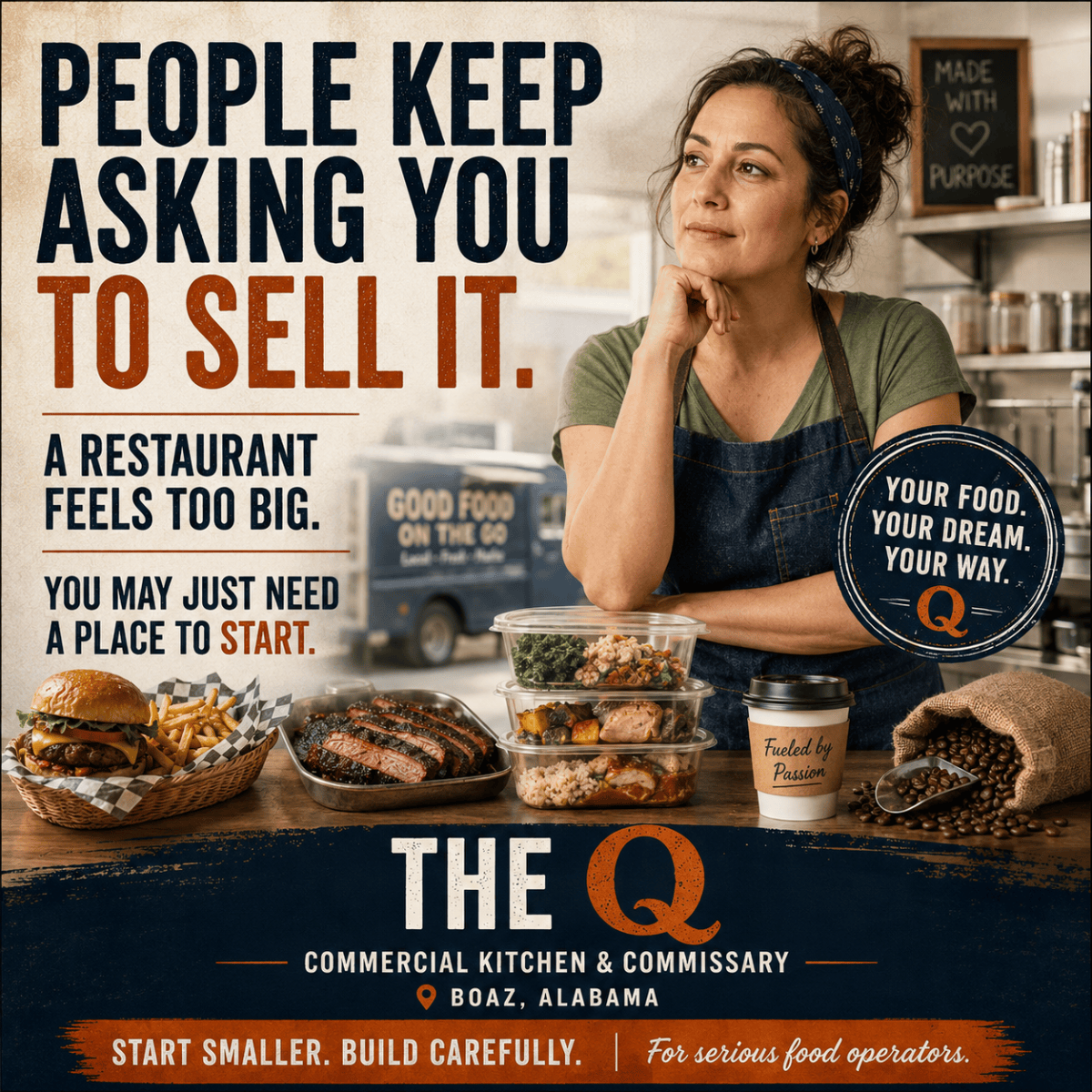
A food business does not always begin with a business plan.
Sometimes it begins with a question.
“Do you sell this?”
Or:
“You ought to make this for people.”
Or:
“How much would you charge?”
Or:
“Can I order some next week?”
At first, those comments may feel like ordinary compliments. Somebody liked the sauce. Somebody liked the BBQ. Somebody liked the chicken salad, the casserole, the dessert, the taco, the meal-prep plate, or the coffee.
That is encouraging.
But if the same question keeps coming back, it may become something more.
It may become a small signal.
Not a guarantee.
Not a business yet.
Not a reason to quit a job or sign a restaurant lease.
But maybe a signal worth taking seriously.
Compliments are not the same as demand
People say nice things about food all the time.
That does not automatically mean there is a business.
A person may love your ribs at a family gathering and still never pay for a weekly order. A friend may praise your dessert and still not understand what it would cost to produce, package, label, and sell it. A neighbor may say, “You should open a restaurant,” without having any idea what a restaurant actually requires.
So compliments should not be mistaken for demand.
But repeated questions deserve attention.
When people keep asking whether they can buy something, order something, pick something up, or tell others about it, the question changes.
It is no longer only:
“Is the food good?”
The better question becomes:
“Is there a simple, legal, practical way to test whether this could become something real?”
That is a very different question.
A restaurant may be too big
For many people, the first imagined step is too large.
They think a food business means opening a restaurant.
That means rent, equipment, employees, utilities, insurance, inspections, inventory, signage, marketing, long hours, a large menu, customer seating, and constant pressure.
For most beginning food operators, that may be too much too soon.
A full restaurant is not the only possible beginning.
A smaller beginning may be more realistic.
One product.
One pickup day.
One weekly menu.
One preorder list.
One focused offering.
One approved kitchen schedule.
One clear way for customers to receive the food.
A smaller beginning does not remove the need for seriousness.
It simply reduces the size of the first step.
Home may not be enough
Many good food ideas begin at home.
That is natural.
But selling food to the public can quickly raise legal, practical, and food-safety questions. Depending on the product and the kind of sale, a home kitchen may not be enough. The operator may need a permitted commercial kitchen, approved storage, refrigeration, warewashing, packaging space, or a plan that satisfies the Health Department.
That is often where the idea stalls.
The food may be good.
The interest may be real.
The person may be capable.
But the next step feels unclear.
That unclear middle space is one reason The Q exists.
Start smaller, but clearly
The Q is not built around the idea that everyone who cooks well should immediately start a food business.
Some food should remain a hobby.
Some ideas are not ready.
Some people are not prepared for the discipline of food production, pricing, scheduling, customer service, cleaning, and compliance.
But some people are ready for a serious conversation.
They may not need a restaurant.
They may need a legal place to start.
They may need scheduled kitchen access.
They may need refrigeration or dry storage.
They may need a pickup model.
They may need help thinking through what the Health Department requires.
They may need a way to test demand before taking on more risk.
That is the kind of operator The Q is interested in.
Not casual.
Not careless.
Not vague.
Serious, but early.
One thing may be enough
A beginning food operator may think the menu has to be large.
It usually does not.
In fact, a smaller menu may be better.
One strong item can teach more than twenty weak ones.
A focused beginning can help the operator control food costs, production time, storage needs, customer expectations, and quality. It can also help customers understand what is being offered.
One sauce.
One BBQ pickup day.
One dessert box.
One chicken plate.
One weekly meal-prep menu.
One taco pack.
One burger night.
One coffee product.
If people already remember one thing, that one thing may be the right place to begin.
The first step is a conversation
The Q cannot decide whether someone should start a food business.
That decision belongs to the operator.
But The Q can help ask better questions.
What are people asking you to sell?
How often are they asking?
Would they actually pay for it?
Can the product be made consistently?
What would it cost?
How would orders be taken?
How would pickup work?
Would you need kitchen access, storage, refrigeration, freezer space, warewashing, smoker or chargrill access, or some other support?
What does the Health Department require?
What is the smallest version of the idea that could be tested clearly?
Those questions matter.
They move the idea from compliment to plan.
Maybe the question is worth answering
If people keep asking you to sell your food, you do not have to rush.
You do not have to open a restaurant.
You do not have to risk everything.
But you might need to listen carefully.
Sometimes the repeated question is telling you something.
Maybe the food is good.
Maybe the interest is real.
Maybe the first step does not have to be huge.
Maybe the first step is simply a conversation about what a legal, practical, smaller beginning could look like.
That is the kind of conversation The Q was built for.
The Q — Commercial Kitchen & Commissary
106 South Main Street
Boaz, Alabama
The Q exists for serious food operators who need a legal, practical place to start smaller, operate safely, and grow carefully.
Call or text 256-557-0517 to schedule a tour or conversation.


