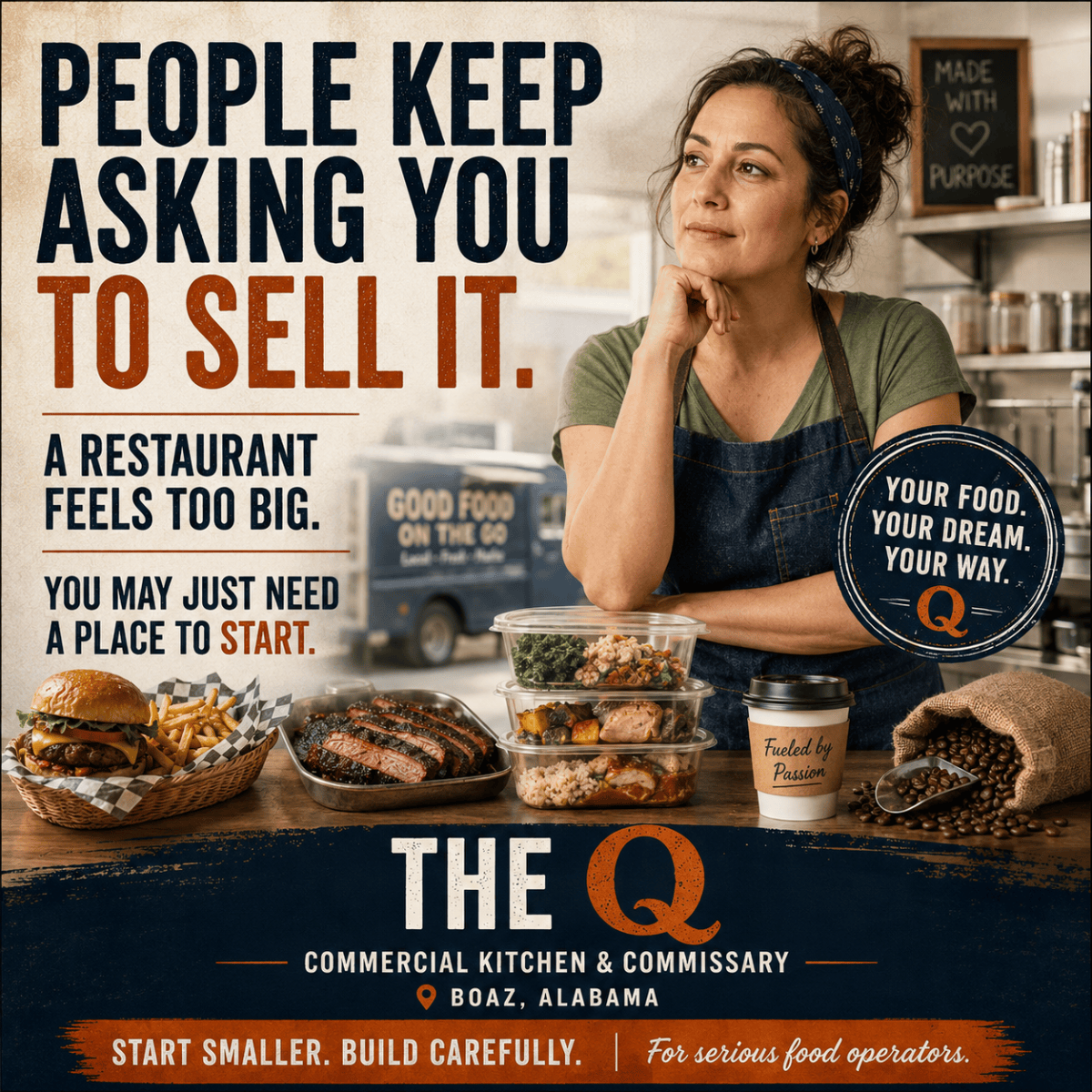
A beginning food operator may think the first menu has to be big.
That is understandable.
Restaurants have menus.
Food trucks have menus.
Catering companies have menus.
Meal-prep services have menus.
Customers seem to expect choices.
So the person with a food idea may start adding too much too soon.
A sauce becomes five sauces.
A chicken plate becomes ten plates.
A dessert idea becomes a full bakery list.
A BBQ idea becomes ribs, pulled pork, brisket, chicken, sides, desserts, drinks, and family packs before the first real pickup day ever happens.
A meal-prep idea becomes breakfast, lunch, dinner, keto, low-carb, high-protein, family meals, individual meals, and custom orders.
The dream gets bigger.
But the beginning gets harder.
Sometimes the better first question is not:
“How much can I offer?”
The better first question is:
“What is the one thing people already remember?”
People often ask for one thing first
A food business does not always begin with a menu.
Sometimes it begins with one item people keep asking about.
The sauce they want you to bottle.
The chicken salad they ask you to bring again.
The BBQ they say you should sell.
The casserole someone wants for a family gathering.
The dessert people remember after a meal.
The meal-prep plate that makes someone say, “I would order this every week.”
That repeated request matters.
It does not prove there is a business.
But it gives the operator something to pay attention to.
If people keep asking for the same thing, that one thing may be the right place to begin.
A small menu can be a strength
A limited menu may feel too small.
But in the beginning, it can be a strength.
A smaller menu is easier to explain.
It is easier to price.
It is easier to shop for.
It is easier to prep.
It is easier to store.
It is easier to make consistently.
It is easier to package.
It is easier for customers to understand.
A large menu can create the illusion of seriousness. But a large menu also creates more decisions, more inventory, more waste, more prep time, more storage needs, more opportunities for mistakes, and more pressure on the operator.
A focused menu forces clarity.
What are you known for?
What do people ask for?
What can you make well, safely, and repeatedly?
What can customers understand quickly?
What can you produce without burying yourself?
Those are serious business questions.
One product can teach the business
One good food item can teach an operator more than a scattered menu.
It can teach whether people will actually pay.
It can teach whether the price works.
It can teach whether the food cost is reasonable.
It can teach whether the process can be repeated.
It can teach how much time production really takes.
It can teach what packaging is needed.
It can teach how pickup should work.
It can teach whether customers come back.
That learning matters.
Before an operator takes on a full restaurant, a full food truck schedule, or a large weekly menu, it may be wiser to test one focused offering.
One BBQ pickup day.
One dessert box.
One weekly meal-prep menu.
One chicken plate.
One taco pack.
One burger night.
One sauce.
One coffee product.
One thing done well.
Starting smaller still requires structure
A smaller beginning does not mean an informal beginning.
If food is being sold to the public, the operator still has to think about legality, food safety, storage, refrigeration, cleanup, scheduling, ordering, pricing, packaging, and customer handoff.
That is where many food ideas get stuck.
The food may be good.
The interest may be real.
But the operator does not know how to move from compliments to a legal, practical first step.
The Q exists for that middle space.
Not everyone who cooks well needs a commercial kitchen.
Not every compliment should become a business.
But some ideas deserve a serious look.
And sometimes the serious look begins with one product, one schedule, one approved kitchen arrangement, and one way for customers to order or pick up.
A smaller beginning can reduce risk
A full restaurant is a major commitment.
Rent.
Equipment.
Employees.
Utilities.
Insurance.
Inventory.
Long hours.
A large menu.
Customer seating.
Daily pressure.
Some operators may eventually need that.
But not at the beginning.
A smaller beginning can reduce risk.
It can help the operator learn before expanding.
It can show whether the idea has real demand.
It can reveal problems while they are still manageable.
It can give the operator time to improve the product, the price, the process, and the customer experience.
A smaller beginning is not a lesser beginning.
It may be the wiser one.
The Q is interested in serious beginnings
The Q — Commercial Kitchen & Commissary exists to help serious food operators start smaller, operate legally, work safely, and grow carefully.
That may include kitchen access.
It may include storage.
It may include refrigeration.
It may include a pickup model.
It may include commissary support.
It may include other approved services depending on the operator and the plan.
But before any of that, the first question is simple:
What are you trying to build?
And often, an even better question comes before that:
What do people keep asking you to sell?
If the answer is clear, maybe you do not need to start with everything.
Maybe one good food item is enough to begin.
The Q — Commercial Kitchen & Commissary
106 South Main Street
Boaz, Alabama
The Q exists for serious food operators who need a legal, practical place to start smaller, operate safely, and grow carefully.
Call or text 256-557-0517 to schedule a tour or conversation.


